
Political parties shape local elections through partisan committees. Here’s how they work
Between 12,000 and 25,000 New Jersey residents serve on Democratic or Republican county committees that influence local government. Learn more about how they work and how you can run to represent your voting district.

In early 2024, the Bloomfield Democratic Committee in Bloomfield, N.J., made headlines following an unprecedented process for filling the mayoral vacancy left by its chairperson, Michael Venezia, as he stepped down from the Bloomfield town council and into the role of State Assemblyman.
Under Venezia’s chairmanship, the committee met with little notice in January to propose Democratic party candidates to succeed himself as Bloomfield mayor.
State law says that committees should propose three people to fill a vacancy, and the municipal government appoints one of the three. Instead, the Bloomfield Democratic Committee also held an unofficial vote, portraying Venezia’s preferred candidate as the legitimate choice. “I urge the members of the township council to respect the clear majority opinion of the Bloomfield Democratic Committee,” Assemblyman, committee chair, and former mayor Venezia said.
(The Bloomfield council followed state law and selected one of the three BDC nominees as interim mayor. It was not Venezia’s preferred candidate – a clarification we’re adding after publishing based on feedback from readers.)
This raised questions about how local political party committees in Essex County and New Jersey shape local government and what rules their members must follow. With two representatives per party per election district, anywhere from 12,000-25,000 Democratic and Republican party members statewide serve on committees with influence over local elections.
But, there are few state laws surrounding county and local party committees. And if its members don’t create clear boundaries, they risk being run by a “party boss” or “political machine” where one or a handful of people maintain control over party operations, candidates for office, and legislative agendas.
The Jersey Bee produced this explainer on local political party committees to help voters understand how they shape local government and how they can run for a committee seat.
What is a county or municipal party committee?
Local political party committees are volunteers elected by voters in local Democratic or Republican primaries to coordinate the party’s operations in the area, endorse candidates, and engage residents.
Committee members are elected during party primaries to represent their county election districts. Each county committee member also serves on their municipal committee, which comprises election districts within the town or city.
Party committee members have the right to:
- View the committee’s financial records.
- Access the committee’s bylaws within the first 48 hours of membership.
- Propose and vote on bylaw adoption or changes.
- Propose and review prospective party candidates.
- Propose candidates to fill vacant elected office positions, like the municipal mayor.
What does a county or municipal party committee do?
Committees coordinate party operations in their community, including:
- Nominating candidates for vacancies.
- Determining which candidates for elected office receive the party’s fundraising support.
- Canvassing and engaging voters in get-out-the-vote campaigns.
Committees meet at least once annually for reorganization meetings to elect members to executive positions like leadership. Unlike town council meetings, committee meetings are not open to the public because political parties are private organizations.
Committees may also meet more often, depending on their bylaws.
How is a municipal party committee governed?
Each party committee has its own bylaws, a document written by committee members that defines the organization’s roles, responsibilities, and processes, such as candidate screenings or officer selection.
While committees adopt their own bylaws, they are all administered by a chair, one member elected by the rest of the membership who presides over meetings and provides others with copies of the committee bylaws. Additional responsibilities vary depending on the group’s bylaws.
The chair is responsible for ensuring new members receive a copy of the committee’s bylaws, and any member who requests a copy must receive it within 48 hours.
How do county or municipal party committees affect my local government?
Party committees can have a substantial impact on their communities, according to Yael Niv, president of Good Government Coalition of New Jersey. That depends on its members and voter demand.
State law around county committees is “not very prescriptive,” Niv said. Since they’re private organizations, “there is only some extent to which the law dictates how they run their business.”
That undefined freedom to shape elections has led to reforms in some New Jersey communities.
In 2021, the Democratic committee (MDMC) in Maplewood, N.J., changed its election ballot design to make primary elections fairer.
That year, there was a vacant township committee seat with no incumbent running to fill it, and unfamiliar people were seeking the MDMC’s endorsement.
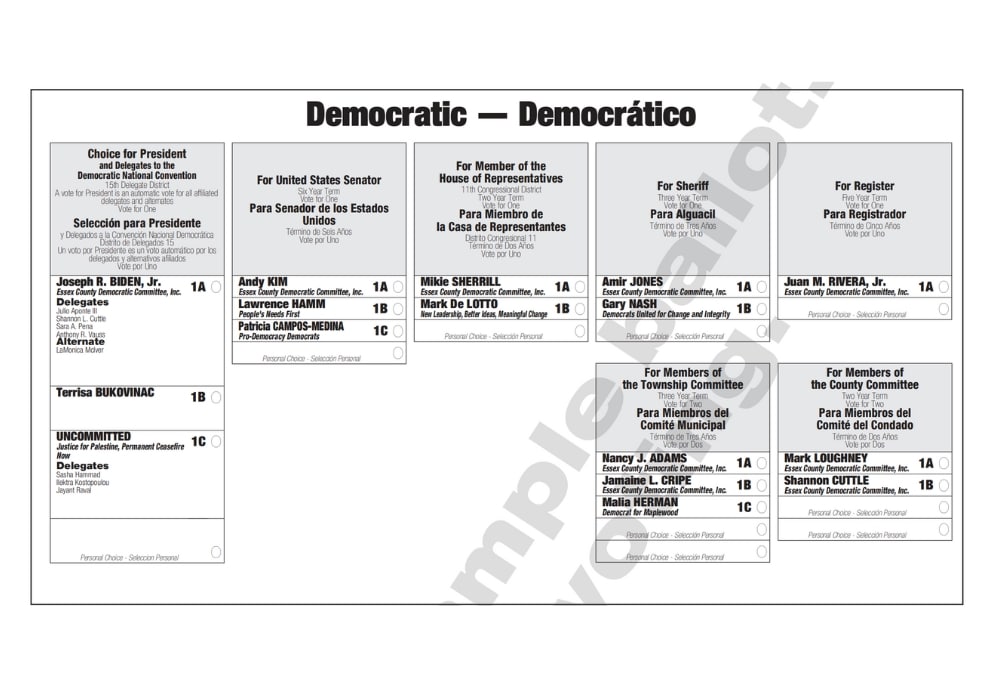
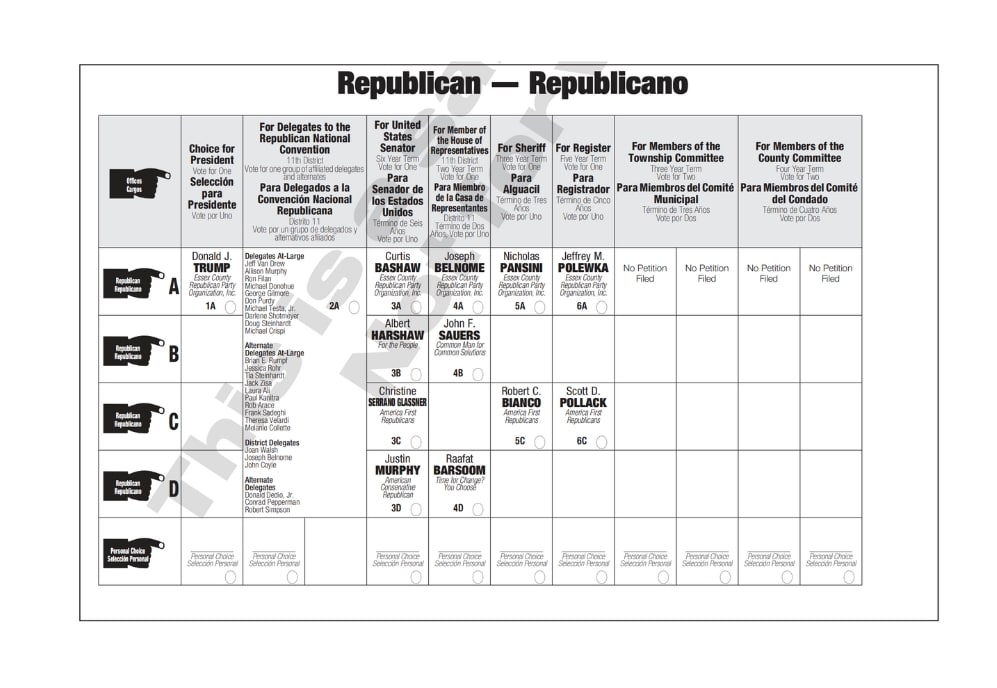
Previously, party-backed candidates in Maplewood were grouped together on a single row or column – a statewide system known as “the line” – which has historically shaped electoral outcomes to favor party insiders and incumbents.
MDMC members formed a subcommittee led by Rebecca Scheer and former Maplewood Mayor Fred Profeta to take a closer look at the “the line’s” impact on candidate diversity.
“It wasn’t so much [about] the county line…It was the endorsement, which translated to the county line,” Profeta said.
MDMC launched a pilot program where they endorsed multiple candidates and arranged their names in groups under the title of the office they were seeking. The committee wrote this new policy into its bylaws one year later, in 2022.
For two years, Maplewood followed this “office-block” format where candidate names are grouped under the title of the office. This year, all New Jersey Democratic primary ballots will follow the office-block format after a 2024 state court ruling.
How are local political party committee members selected?
Democratic and Republican party voters elect local party committee members during primary elections to represent their election district on the committee. Every county election district has two representatives per party. Election cycles vary by county and can be verified with its county clerk.
To run for election as a district representative, prospective candidates must be at least 18 years old and registered to vote with the party they represent. They can request a nominating petition from their municipality’s clerk and should verify the number of signatures needed before the filing deadline, typically in March.
Residents can join without running, too, Niv said. Municipal party committees can appoint a resident to fill a vacant seat during a “quorum” meeting where at least 15 percent of members need to be present. Appointed municipal committee members also serve on the county committee and vice versa.
Prospective candidates can volunteer with the committee to meet current members and build a network for their campaign. This includes volunteering on subcommittees, campaigns, or events.
How can I find my election district?
Use New Jersey’s Election Districts map to find which election district you live in.
Type in your address and zoom out from the map until district boundaries are visible. Click the section within your address and look for “ELECD_CODE” in the pop-up window. The corresponding number is your election district.
How can I find my local party committee representatives?
Some municipal and county party committees may have membership rosters available online. Otherwise, a complete list of members can be requested through the county or municipal clerk.
Where can I find bylaws for my local party committee?
Party committee bylaws are available to the public either through the committee’s website or through the municipal clerk.
For example, Essex County’s Republican and Democratic party committee bylaws are accessible on the county’s websites.
Municipal party committees can adopt their own bylaws that may be different from the county. Those can be requested from the municipal clerk if they are not available online.
How are local party committee members removed?
Local party committee members can lose their membership by:
- Moving out of their election district or county.
- Resigning.
- Being removed by the committee.
Party officials, including a committee chairperson, can also be removed by a vote of the committee.
“Even if the [chairperson] has all the power, the [chairperson] has to be reelected,” Niv said. “It’s difficult. Because these [are] very powerful [people]. They have a lot of money and a lot of power, and it’s hard to unseat them. But it’s not impossible.”
Learn more
Good Government Coalition of New Jersey’s “County Committees 101” guide informed the production of this resource. It can be found here.
Help improve this resource
New Jersey’s political committees can be difficult to investigate. Help The Jersey Bee improve this resource by volunteering your expertise on the subject. Contact us here or email connect@jerseybee.org to learn about ways to help us explain this subject to our community.
Authors


Related Articles

Bloomfield Mayor Mundell to address safety concerns Dec. 13 after firefighter sues town over racism
From Bloomfield Mayor Jenny Mundell.

Belleville suspends alternate street parking and parking meters for holiday season
From Belleville Township.
Newark’s Ironbound residents can share feedback on where to measure air quality in online survey
From Ironbound Community Corporation.
