
How rent control works in New Jersey
More than one-third of the state’s households rent their homes, but there is no statewide system of rent control. Here’s how to find out if you’re protected by rent control rules in your New Jersey town or city.

This article is part of the NJ 2025 Reporting Fellowship, in collaboration with 15 local and community news organizations, the Center for Cooperative Media at Montclair State University, and NJ Spotlight News. The reporting in this collaboration focuses on immigration, education, healthcare, the economy, and the environment from the perspectives of diverse communities in New Jersey.
There is no statewide rent control system in New Jersey. The state allows each municipality to decide whether to limit how much landlords can charge and increase rent. More than one-third of New Jersey households rent their homes.
As of 2025, approximately 1 in 5 of New Jersey’s 564 municipalities have rent control, according to the Department of Community Affairs, a statewide agency that oversees and supports local government. A Rutgers University study found that most municipalities with local rent control laws are in Essex, Hudson, Bergen, and Middlesex counties – the state’s most populous.
Rent control enforcement is difficult to track because each municipality has its own rules for acceptable rent increases, tenant and landlord protections, and exceptions to those rules.
Legislation was introduced in the N.J. Assembly and Senate to allow tenants to ask the Department of Community Affairs to review alleged violations of local rent restrictions. While it has passed in the Assembly, it has not advanced to a vote in the Senate.
The Jersey Bee produced this explainer to help residents understand how rent control laws work across New Jersey.
In this resource:
- How is rent control determined in New Jersey?
- What does a rent control board or office do?
- What is the rent control law in my municipality?
- How is rent control enforced in New Jersey?
- What responsibilities do landlords of rent-controlled units have?
- How can I confirm whether my unit is rent-controlled?
- How do I report a rent control violation?
How is rent control determined in New Jersey?
Municipal governments set their own rules for rent control, and can limit annual rent increases by a set percentage or to match inflation, measured by the consumer price index.
Towns and cities can also allow rent to increase or decrease depending on other factors, according to the Rutgers University “Rent Control in New Jersey” study:
- Building capital improvements.
- Building rehabilitation.
- Low return on investment.
- Substandard housing conditions.
- Changes to taxes and service fees.
- Unit vacancy.
State law exempts some buildings and units from rent control, including:
- Newly constructed buildings for 30 years after construction is completed.
- Units owned or subsidized by:
- N.J. Housing Mortgage Finance Agency.
- U.S. Department of Housing and Urban Development.
- N.J. Public Housing and Development Authority.
Municipalities with rent control may create boards or departments responsible for monitoring landlord compliance, hearing tenant-landlord disputes, and ensuring legal rents are registered and adhered to. These groups can be called a rent leveling board, office of landlord-tenant relations, or rent control office, among other names.
What does a rent control board or office do?
Rent control boards can be appointed by the municipal council or mayor and may include tenants, landlords, and homeowners.
Rent control boards and offices can:
- Review proposed rent increases by landlords.
- Hold hearings to resolve disputes between landlords and tenants regarding rent increases or related issues.
- Order rent rollbacks or impose fines on landlords, depending on local ordinances.
People can find their local rent control board’s contact information on their municipality’s website or by contacting their municipal clerk.
What is the rent control law in my municipality?
The N.J. Department of Community Affairs publishes an annual list of municipalities with and without rent control ordinances.
The Jersey Bee created the dashboard below based on the DCA’s 2025 list. Residents can find information about their towns or cities, links to local rent control board websites and ordinances, and phone numbers to contact for more information.
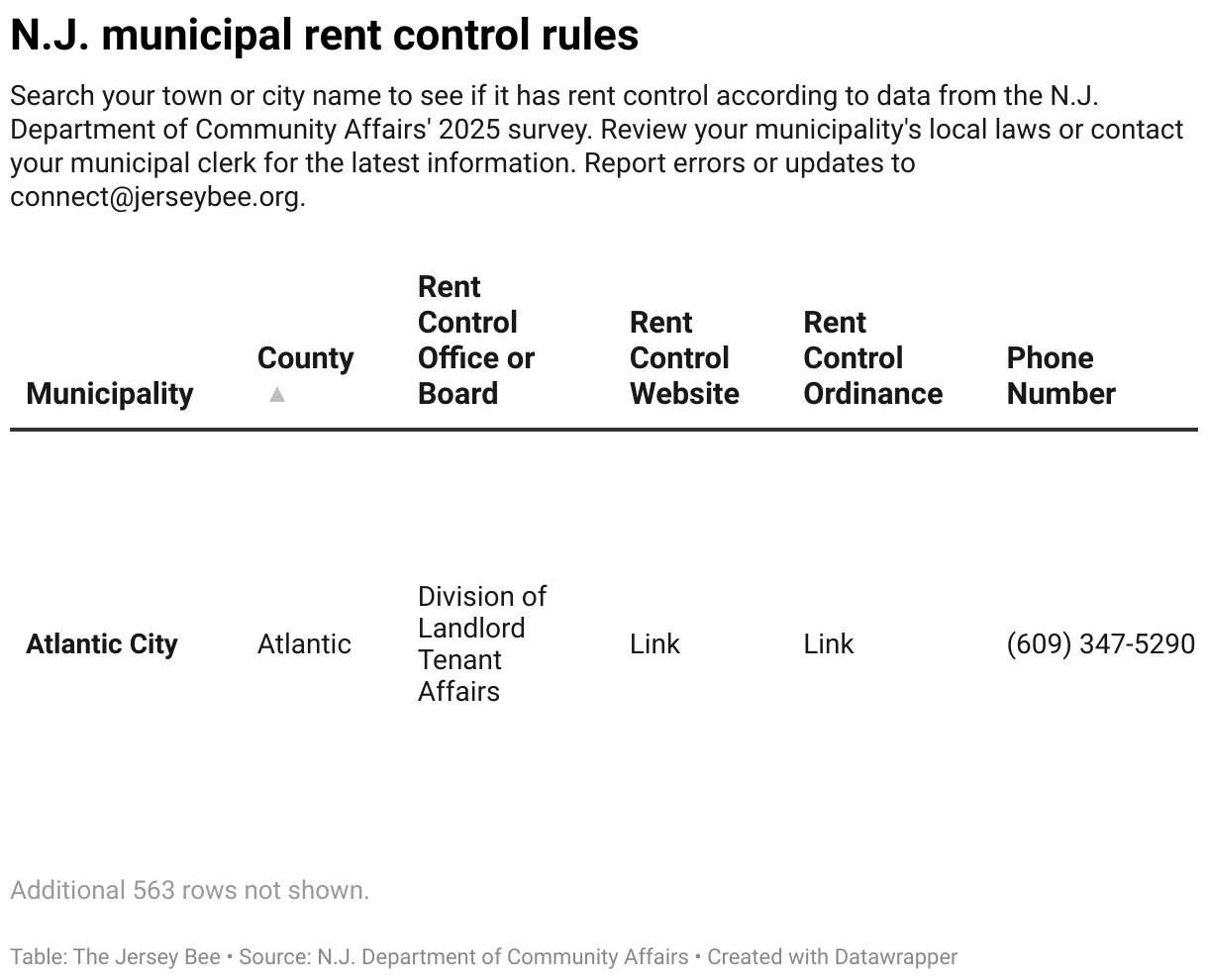
The data in this chart is from the N.J. Department of Community Affairs’s 2025 survey. References to “CPI” are to the consumer price index and indicate the municipality uses the index in a formula to calculate the increase. Request access to The Jersey Bee’s version of the DCA data by emailing connect@jerseybee.org.
How is rent control enforced in New Jersey?
Rent control enforcement varies across municipalities, though local rent control boards can serve as the first resource for renters. Tenants can file complaints with these boards or offices if they believe their rent was improperly increased.
It’s difficult to determine whether municipalities are enforcing their rent control rules, according to Beverly Brown Ruggia, financial justice organizer for New Jersey Citizen Action.
“What’s frustrating [for] housing advocates…is that where the laws are in place, and if the cities and towns took the time to enforce the laws that exist, it should help slow the rising cost of rent and the displacement that’s going on across the state,” Brown Ruggia said.
Brown Ruggia emphasized that tenants need to know their rights – like how to file a complaint against their landlord if they suspect their rent was incorrectly increased – to support enforcement of rent control rules.
Mitchell Kahn of the New Jersey Tenants Organization suggests that renters consider organizing with their neighbors to talk to their mayor, council members, and rent board or office about issues they are experiencing in their building.
“If one tenant is facing a particular kind of problem because of lack of enforcement…probably other people that live in that building or have lived in that building are also facing that problem,” Kahn said. “Which is why it’s important, and tenants have more leverage if they go in as a group and file a complaint about that.”
What responsibilities do landlords of rent-controlled units have?
Landlords must provide notice before any rent increases. They could be required to annually register their rental units with the municipal government, depending on local laws.
Some municipalities do not allow rent increases if a landlord does not follow ordinance rules or if the unit is in poor condition, according to the Rutgers study.
Landlords could face fines and owe back rent if a rent control board or office finds that they improperly increased a tenant’s rent, based on The Jersey Bee’s review of multiple rent control ordinances across the state. A municipality can also reject a rent increase if the unit does not meet required living conditions.
How can I confirm whether my unit is rent-controlled?
Tenants can review The Jersey Bee’s dashboard above to see if their municipality is listed as having rent control. If you’re unsure whether your unit falls under local rent control rules, contact your municipal clerk for more information. The clerk may direct you to the municipality’s rent control board or office, if one exists.
Tenants can ask if their town or city keeps a rent roll, or a list of units in their building and the rents being charged. They can also explore their municipality’s website to find local laws there, according to Ashley Maddison, managing attorney of the Housing Justice Program at Rutgers Law in Camden.
“[The ordinance] would be linked somewhere, hopefully on the web page, where you could search through. I recommend searching for terms like ‘rent control,’ ‘stabilization,’ ‘leveling,’ ‘rent increase,’” said Maddison.
She added that tenants can also ask their local library, where reference librarians may be able to direct them to the correct resources or find local rent control rules online.
“Librarians are all about connecting people with information,” said Maddison. “If you have language accessibility concerns, [the library] can hopefully point you to some resources to assist with that as well.”
Tenants may need to find their unit’s rent history by filing an Open Public Records Act (OPRA) request with their municipal clerk. Request forms and filing processes are available on the municipal government’s website.
LEARN MORE: MuckRock’s guide to submitting OPRA requests in New Jersey
How do I report a rent control violation?
Municipal rent boards or offices may have a webpage on the municipality’s website that explains how to contact the board or file a complaint.
If unsure where to address a complaint, tenants should contact their municipal clerk and ask to be directed to the correct department, said Margaret Fiori, a housing justice corps fellow with Make the Road New Jersey.
If a tenant suspects their rent was improperly increased, they can:
- Contact their municipal clerk or rent board to confirm that local rent control ordinances protect their unit.
- Gather records showing the unit’s rent history from past lease agreements or public records.
- Submit a complaint to their local rent control board or similar municipal department.
Complaints may explain rental history, showcase increases, and provide dates and summaries of landlord-tenant communication, including how landlords notified tenants of rent increases by phone call, text, email, or letter.
“I think it’s important for people to remember that there may be no increase to the actual dollar of ‘base rent,’ but adding on additional fees for other random things might be something that goes against your local rent control ordinance,” said Maddison.
The process for reviewing and addressing complaints varies by municipality, but may include a public hearing with the local rent control board.
If the municipality finds the rent increase unlawful, local ordinances may allow for:
- The board to order the landlord to roll back the rent to its legal amount.
- Overcharged rent to be refunded to the tenant.
- Landlord fines or other penalties.
If a tenant or landlord disagrees with the board’s decision, they may have the right to appeal within the municipal system or in court, depending on local laws.
Learn more
Legal Services of New Jersey published “Tenants’ Rights in New Jersey,” a legal manual for tenants and landlords. It includes information on joining tenant associations, interpreting lease agreements, finding a lawyer, and other processes. Read it here.
Help improve this resource
New Jersey’s rent control laws are complicated. Help The Jersey Bee improve this resource by volunteering your expertise on the subject. Contact us here or email connect@jerseybee.org to learn about ways to help us explain this subject to our community.
Authors


Related Articles

Cómo funciona el control de alquileres en Nueva Jersey
Más de un tercio de los hogares del estado alquilan sus viviendas, pero no existe un sistema estatal de control de alquileres. Aquí te explicamos cómo averiguar si estás protegido por las normas de control de alquileres en tu ciudad o pueblo de Nueva Jersey.

Los candidatos a la gobernación de Nueva Jersey en 2025 responden preguntas sobre segregación y equidad
The Jersey Bee preguntó a 12 candidatos a la gobernación de Nueva Jersey cuáles eran sus planes para un estado más justo y equitativo. Seis respondieron. Esto es lo que contestaron.

N.J. 2025 governor candidates answer questions on segregation and equity
The Jersey Bee asked 12 candidates for governor in New Jersey their plans for a more just and equitable state. Six responded. Here’s what they said.
