
How to find public assistance without violating public charge rules in New Jersey
Public charge determines what public resources a visa or green card applicant can rely on in the United States.

This article was originally published by Documented, an independent, non-profit newsroom dedicated to reporting with and for immigrant communities in New York City. It’s republished here with New Jersey-specific information as part of a collaboration between Documented and The Jersey Bee. The original article can be accessed here.
Subscribers of The Jersey Bee’s food access hotline asked us for information about how the public charge rule impacts immigrants seeking food assistance or other basic needs.
In this article, Documented interviewed two immigration experts, Health Justice Staff Attorney Arielle Wisbaum at New York Lawyers for the Public Interest and Senior Staff Attorney Ariel Brown at Immigrant Legal Resource Center, to clarify common myths and misunderstandings in the immigrant community about the public charge policy. They also analyzed the potential impact of the 2024 presidential election on the public charge policy.
What is public charge?
The public charge rule is not a new concept. The U.S. Congress established the public charge inadmissibility test in 1883. Simply put, public charge determines if someone applying for a visa or green card would depend on public resources if they were to reside in the U.S. If the government determines that the applicant is likely to become a public charge, they can deny their application.
Brown noted that the rule didn’t become a significant concern until the first Trump administration, which attempted to expand its application in 2019. Trump tried to include non-cash assistance such as non-emergency Medicaid in the public charge analysis, causing a huge chilling effect. As a result, many immigrants became afraid to use any type of public benefits.
Wisbaum pointed out that, in fact, the scope of the public charge rule is limited. She said that it depends on the type of immigration application being submitted and the specific public benefits. Immigration officers also consider a range of factors, including health, age, income sources, education and skills, family size, and potential sponsors, when determining whether an applicant is likely to become a public charge.
Will using any public benefit make me a public charge?
No. The public charge rule only applies to certain types of public cash assistance for people with limited or no income. Public cash assistance includes Supplemental Security Income (SSI), cash assistance under the Temporary Assistance for Needy Families (TANF) program, and state and local cash assistance programs.
One of the biggest changes the Biden administration made to the public charge rule is that it explicitly clarified that individuals receiving non-cash benefits, such as food stamps, food pantry services, housing vouchers, or Medicaid, are not considered in the public charge analysis. There is one exception for Medicaid: if someone is receiving long-term institutionalized care, such as in a nursing home or psychiatric facility, that may be considered in the public charge evaluation.
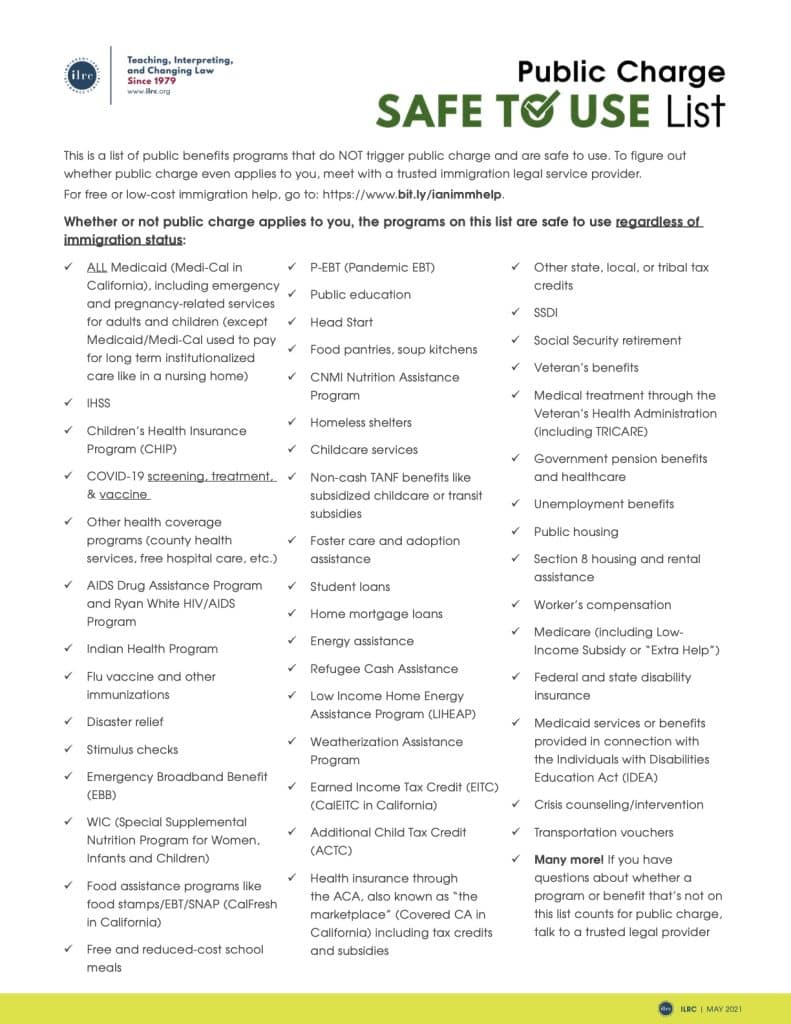
LEARN MORE: Read the full list of what public assistance programs USCIS does not consider as public charge.
Do public charge rules apply to all immigrants?
No. The public charge rule applies to immigrants who are seeking to enter the United States or to adjust their status to become lawful permanent residents, also known as green card holders. This includes those applying for visas or green cards from within the U.S. or abroad. It doesn’t apply to many non-citizen immigrants, green card holders, and citizens.
Click here to see the full list of who are exempt from public charge on the U.S. Citizenship and Immigration Services website. Consult with a lawyer for the most up-to-date information.
Will other family members’ benefit use impact public charge determinations?
No. An immigrant’s own use of public benefits is the only factor considered in the public charge determination, not their family members’ use of benefits. For example, many mixed-status families have U.S.-citizen children. It’s acceptable for these children to access any benefits for which they qualify, including food stamps and cash assistance. Importantly, utilizing these benefits has no impact on the immigration status of the family member who is applying.
LEARN MORE: Find food pantries in Essex County and other food aid in New Jersey
Will applying for public benefits automatically lead to deportation?
No. If someone applies for public benefits, their information will not be shared with ICE, meaning that ICE will not target individuals solely based on their applications for public assistance. Public charge comes into play when someone is deemed a public charge during a judicial proceeding when their green card application may be denied. However, this does not lead to deportation; it simply means they may be ineligible for a green card.
Will public charge impact my public benefit eligibility?
No. Eligibility for public benefits is distinct from public charge considerations. Public charge relates to the immigration implications of using public benefits but does not affect an individual’s eligibility to receive them. If someone is unsure about their qualifications for certain benefits, they should consult the relevant benefits-granting agency to determine factors such as income level, age, immigration status, and other requirements.
How a new federal administration could potentially impact public charge
Any drastic changes to the public charge rules, such as the Trump administration’s expansion to include Medicaid, would take a long time to implement even under a new administration. This is because the rules are codified in regulations, and any major overhaul would require a lengthy notice and comment period, as well as potential legal challenges.
The Biden administration’s 2022 regulation that excluded non-cash benefits like Medicaid from public charge consideration would make it more difficult for a future administration to undo those changes. Those exemptions would require significant effort to overturn.
While a new administration could potentially try to expand the public charge rules again, the process would be lengthy and face significant opposition. For example, when the Trump administration proposed changes to the public charge rule, they received over 200,000 public comments, which significantly slowed down the process.
How to access benefits without being a public charge
Here are some online resources for immigrants to navigate public charge policy.
Use this online quiz from KeepYourBenefits.com to check if your public benefit use could be considered a public charge.
The Immigrant Legal Resource Network has a factsheet and other resources on public charge rules, available in English, Spanish, and Chinese. That includes a “safe to use” list you can see below.
Help improve this resource
Do you know something about this topic we should consider adding to this article? Contact us here.
Authors


Related Articles
Cómo protegerse de las estafas que fingen ser agencias de inmigración o abogados en Nueva Jersey
Correos electrónicos y mensajes fraudulentos prometen falsamente representación legal para obtener una “Green Card” o residencia permanente, entre otros servicios de inmigración, a cambio de una pequeña tarifa. Esto es lo que hay que saber.

Cómo pueden protegerse los no ciudadanos cuando hablan con agentes de ICE en Nueva Jersey
Lo que se le dice (o no se le dice) a los agentes del Servicio de Inmigración y Control de Aduanas de los Estados Unidos (ICE, por sus siglás en inglés) podría protegerlo a usted y a su familia si ICE entra en su casa o lugar de trabajo.
Cómo prepararse para una comparecencia inicial ante el tribunal de inmigración en Nueva Jersey
Esto es lo que necesitas saber sobre las comparecencias ante el tribunal de inmigración y lo que sucede si no te presentas.
