
Local issues lead federal debate in 10th District special election to complete Payne Jr.’s term
The winner of what appears to be the most competitive congressional election in New Jersey’s history will serve what is likely the shortest congressional term in the state to date. Here are some of the local issues Democratic candidates discussed with their community at a July 1 forum in Newark.
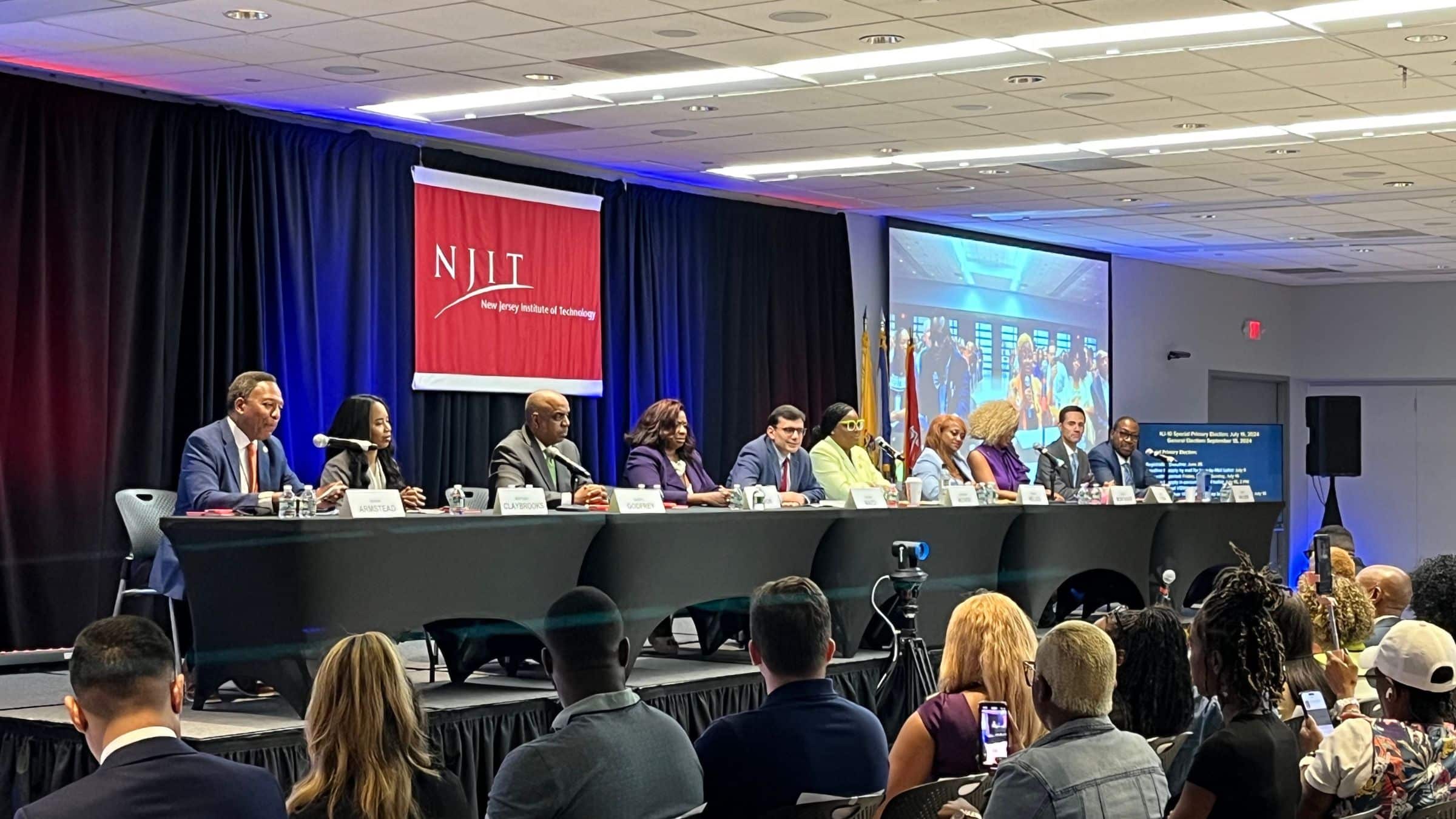
In New Jersey’s 10th Congressional District, 12 candidates are vying for a three-month tenure in the U.S. House of Representatives, marking the shortest congressional term in the state’s history. The winning candidate will fill a vacancy left by the death of Rep. Donald Payne Jr. to represent parts of Essex, Hudson, and Union Counties through Jan. 3, 2025.
The special election is the state’s most competitive congressional primary in recent memory. In 1982, nine Democratic candidates ran statewide for a vacant U.S. Senate seat.
“This is a cultural shift post-line,” Henal Patel, law and policy director at New Jersey Institute for Social Justice, said. “We are seeing a shift of more [candidates] coming in. People aren’t worried about upsetting the party [or] worried about running against the line.”
A 2024 state court ruling prohibited county clerks from printing New Jersey’s Democratic primary ballots with “the line,” a ballot design that allowed party leaders to give primary placement to favored candidates. While there is no ballot “line” because this will be the only race on the ballot, party endorsements typically give a candidate an edge.
NAACP and Urban League branches in the district featured 10 of 11 Democratic primary candidates in a forum at the New Jersey Institute of Technology in Newark on July 1.
About 400 people attended to hear candidates explain how they plan to use federal power to address the top issues raised during the forum, including reparations, affordability, and health equity.
Reparations
New Jersey was the last Northern state to abolish slavery in 1866. Still, its legacy as “the slave state of the North” is manifested today in unequal access for some Black people to healthcare, housing, education, and other necessities. Almost half of all residents in New Jersey’s 10th district are Black.
In 2023, the New Jersey Institute for Social Justice assembled the New Jersey Reparations Council to research and address the present-day effects of slavery in the state. The council plans to present a report next year that outlines reparations proposals for New Jersey and can serve as a national model.
Candidates at last week’s event were asked to propose a federal policy addressing reparations. Most agreed that funds should be set aside for Black families and individuals.
Sheila Montague, a professor at Essex County College who previously taught in the Newark
Public Schools, said she would use federal dollars to assist District 10’s unhoused population..
“In Essex County, 90% of the homeless population is in Newark and 70% [of people who reported experiencing homelessness] are Black. So we need to really put our voice forward,” Montague said, citing a 2023 study by the Monarch Housing Associates.
Alberta Gordon, a district leader in Newark’s South Ward, said she would prioritize distributing funds to families affected by mass incarceration, especially those facing charges for possession of marijuana, which was decriminalized in New Jersey in 2021.
Brittany Claybrooks, a former East Orange councilwoman, said she would help push H.R. 40, a bill that establishes a commission to study and develop reparations proposals for African Americans, to the floor for a vote.
READ: We interviewed Democratic primary candidates running in the 2024 special election to represent NJ-10
Affordability
The forum highlighted affordability as a concern among local residents and candidates pitched policies to address unemployment and the cost of living.
Jobs
Unemployment in the 10th District was nearly 8% in 2022, the highest in the state, according to U.S. Census Bureau data. The district’s median household income was $67,939, the lowest in the state.
Alberta Gordon said she would prioritize broadening employment opportunities for disabled people and formerly incarcerated people.
“Jobs help with all the things that we’re talking about: affordability, health insurance, economic opportunity,” Gordon said.
Darryl Godfrey, a Jersey City resident, and chief operations officer for the New Jersey Redevelopment Authority, said he would require a mandate to ensure more recruitment opportunities and an increase in financial resources for minority- and women-owned businesses.
Godfrey cited a 2024 New Jersey disparity study that showed government contracts were awarded to minority-owned businesses at a percentage much lower than their representation. Black Americans, for example, make up 9% of construction contractors in the state but have received only 0.14% of contracts valued between $65,000 and $5.71 million.
Housing
The median rent in New Jersey was $1,577 in 2022, according to U.S. Census data, 24% more than the national average of $1,268.
“Our affordable housing is not affordable anymore,” Jerry Walker, vice chairman of the Hudson County Board of Commissioners, said about Jersey City.
Walker said that he supports expanding housing programs for low-to-moderate income families.
Candidates were asked to establish a policy for middle-class families that cannot afford market rent and are not eligible for affordable housing.
Alberta Gordon said she would adjust the federal poverty guidelines to increase access to housing subsidies and programs. As of 2024, the poverty income limit for a household of four is $31,200.
Housing in New Jersey is among the least affordable in the country. The National Low
Income Housing Coalition found New Jersey residents would need almost $80,000 per year or $38.08 per hour to afford housing in the state. In parts of the 10th District, the housing affordability wage is $40.15.
Federal poverty guidelines are set by the U.S. Department of Housing and Urban Development. Those household income limits are compared to an area’s median income (AMI) to determine renter eligibility for housing subsidies. Low-income, very low-income, and extremely low-income can take on different meanings depending on the location.
“We know we need funding at the state and federal level to address those of a certain income, including getting rid of the AMI,” said candidate LaMonica McIver, Newark Council president. She suggested establishing new levels of income for middle-class families.
McIver proposed replicating Newark assistance programs, such as offering $20,000 down payments to first-time homebuyers or up to $40,000 for homeowners to renovate their houses.
Childcare
New Jersey has set rates for paying child care assistance for income-eligible families. The rates vary depending on the child’s age and the type of care provider. The Child Care Assistance Program may cover the entire cost of care, but if the provider charges more than the state’s limits, families are responsible for paying the difference. The benefit does not cover additional charges like field trips and late fees.
Community members asked candidates for their policies around school-age childcare expansion programs.
A federal bill to update tax provisions to make child care more affordable was introduced in February of this year. Shana Melius, a former staffer for Rep. Donald Payne Jr. who is now looking to replace him, said Payne co-sponsored the bill after she learned how the district could benefit from the Promoting Affordable Childcare for Everyone Act.
Derek Armstead, the mayor of Linden and another candidate, said he would support expanded funding for child care that creates educational opportunities for children and is accessible to families.
Eugene Mazo, a Duquesne University professor who previously taught at Rutgers University’s Newark campus and Seton Hall University, said that he supports funding early childhood education programs to improve health outcomes in the state. Early care programs like Head Start offer children health screenings, meals, and connections to medical, dental, or mental health services. Childcare programs also increase workforce participation among parents, according to a 2021 Rutgers University study.
The Urban League of Essex County offers an early childhood education program for children up to age 5 in its Newark location. Godfrey said that he would “earmark funds” to support organizations like the Urban League that are “doing the work.”
Health equity
Healthcare access
Medicaid is a publicly funded health insurance program known as NJ FamilyCare in New Jersey. More than one in five New Jersey residents are enrolled in NJ FamilyCare since the state expanded eligibility requirements in 2013 to include families with a four-person household income of less than $43,056.
Claybrooks and McIver said they want to prioritize Medicaid expansion in Congress.
“I talked to a lot of health providers and they said… [people] have a hard time with [Medicaid] payments for mental health,” Gordon said. “I want to… make sure we bring enough federal dollars to be able to [support mental health services].”
Hospitals in the district see some of the most visits for chronic conditions, with Essex County leading the highest percentage of reported chronic health concerns in the state, according to a 2019 New Jersey Hospital Association report.
McIver and John Flora, a teacher in Jersey City Public Schools, said they plan to support increased funding for preventative care for chronic diseases. McIver said she would support expanding mobile health services, which are offered in Newark.
Black maternal health
Black women giving birth in New Jersey are more likely to die or experience complications than white women. Health risk factors like limited access to food, transportation, and safe housing can affect maternal mortality or complications.
Montague said she wants to increase funding for maternal health programs designed for Black women and expand access to prenatal care, postpartum support, and mental health services.
“I will work to address social determinants of health that disproportionately impact Black communities, such as housing instability, food insecurity, and systematic racism. By investing in programs that address these underlying factors, we can improve healthcare outcomes,” Montague said.
Claybrooks said she would support the Black Maternal Health Momnibus Act, a 13-part investment in improving maternal health outcomes. It includes increased funding for maternal healthcare, improved mental health support for incarcerated mothers and diversifying the perinatal workforce. The bill has not moved out of U.S. House or Senate committees since it was introduced in May 2023.
The special primary is scheduled for July 16. Polls will be open from 6 a.m. to 8 p.m. and all typical polling locations will be open.
Authors



Related Articles
Meet the Democratic candidates running in NJ-11 special election primary
Learn about the candidates running in the Feb. 5 Democratic primary for the 11th congressional district special election in New Jersey.

How New Jersey fills congressional vacancies
Here is the process for filling vacancies in the U.S. Senate and House of Representatives in New Jersey.
How to recall elected officials in New Jersey
Learn about the rules, timelines, and requirements for removing elected officials from office before their terms ends in New Jersey.
