
How Essex County falls short on food access (and how you can help)
At least one in five Essex County households face food insecurity. Here’s what The Jersey Bee knows about food access in our community and how you can help us report on it.

Share your experience with food access in Essex County at the survey below this article or find it here.
It’s been four years since the World Health Organization declared the global COVID-19 outbreak as a pandemic and food pantry lines haven’t gotten shorter. In fact, they’re growing.
The looming pressure to keep food on the table has never felt more urgent than in Essex County, where almost one in two households can’t afford the basic cost of living. For these households, this could mean having to choose between paying rent, childcare, or accessing healthcare every month.
In May 2020, The Jersey Bee began to connect with food aid recipients, community providers, and policymakers to improve food access in East Essex County. We established a weekly text message hotline to share place-based food resources and created guides to help residents navigate food assistance. Our founder and editor, Simon Galperin, even pitched in to deliver food and face masks.
Yet one thing crystallized early on: the need for quality, culturally relevant food far outpaced what was available through existing systems, and low-income, disproportionately Black and Latino residents in Essex County were expected to settle for scraps.
This year, The Jersey Bee hired Kimberly Izar, a public health journalist, to report on that system to help more people get fed well in our community. Here is what we know so far and what you can expect going forward.
What we know
In Essex County, at least one in 10 residents – or one in every five households – aren’t able to get enough food to feed themselves at least two days a week. Of them, one-third make too much money – just $26,000 and above – to qualify for federal or state assistance like SNAP or WIC.
“I can’t cook for my boys if I don’t have [food],” one resident told The Jersey Bee.
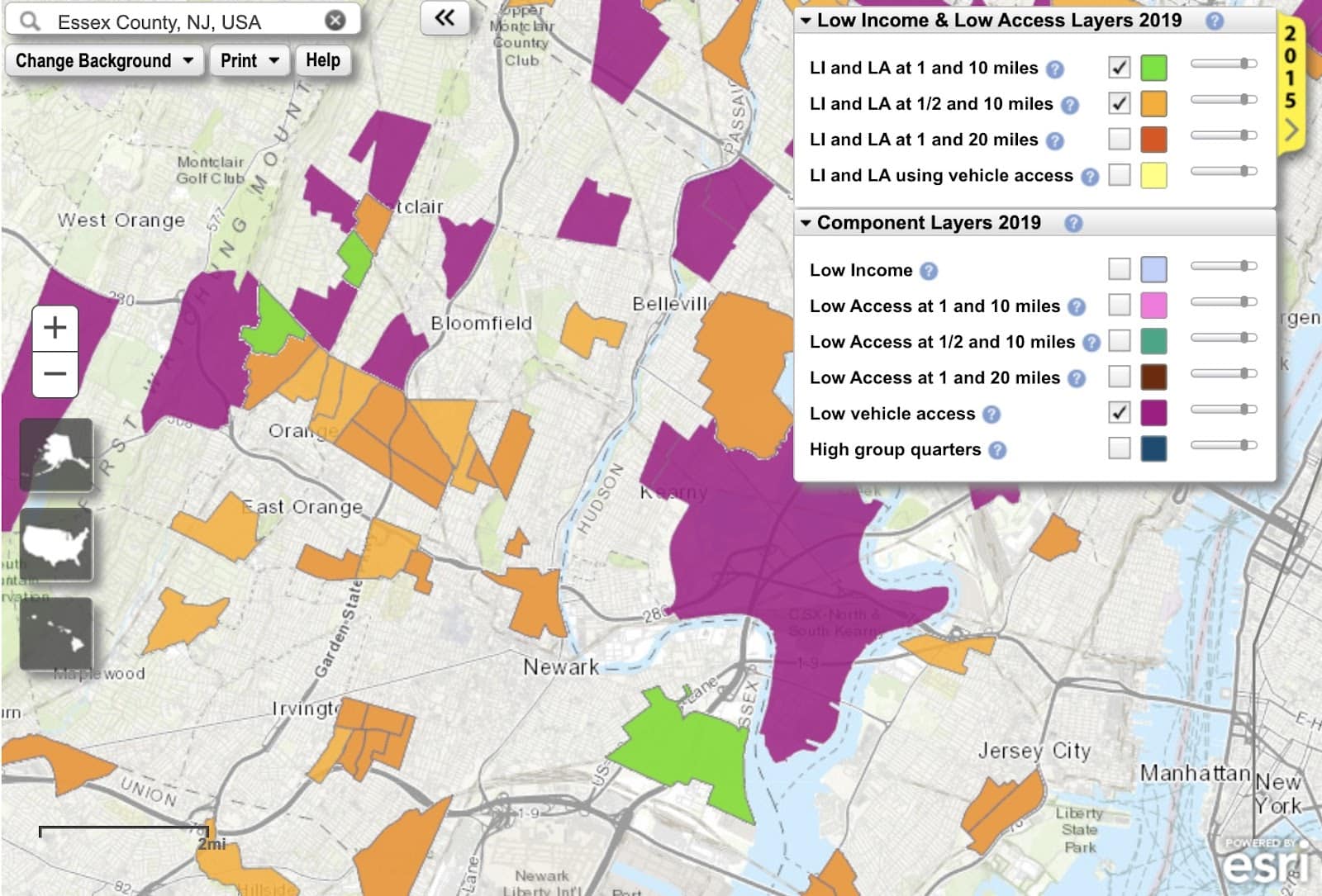
Getting food is also burdensome for many people. Tens of thousands of Essex County residents live in areas the U.S. Department of Agriculture identifies as low access, according to its Food Access Research Atlas.
Almost every municipality in East Essex County has a community where the nearest grocery store or supermarket is hard to access, defined as one-half mile or further from a significant number of people.
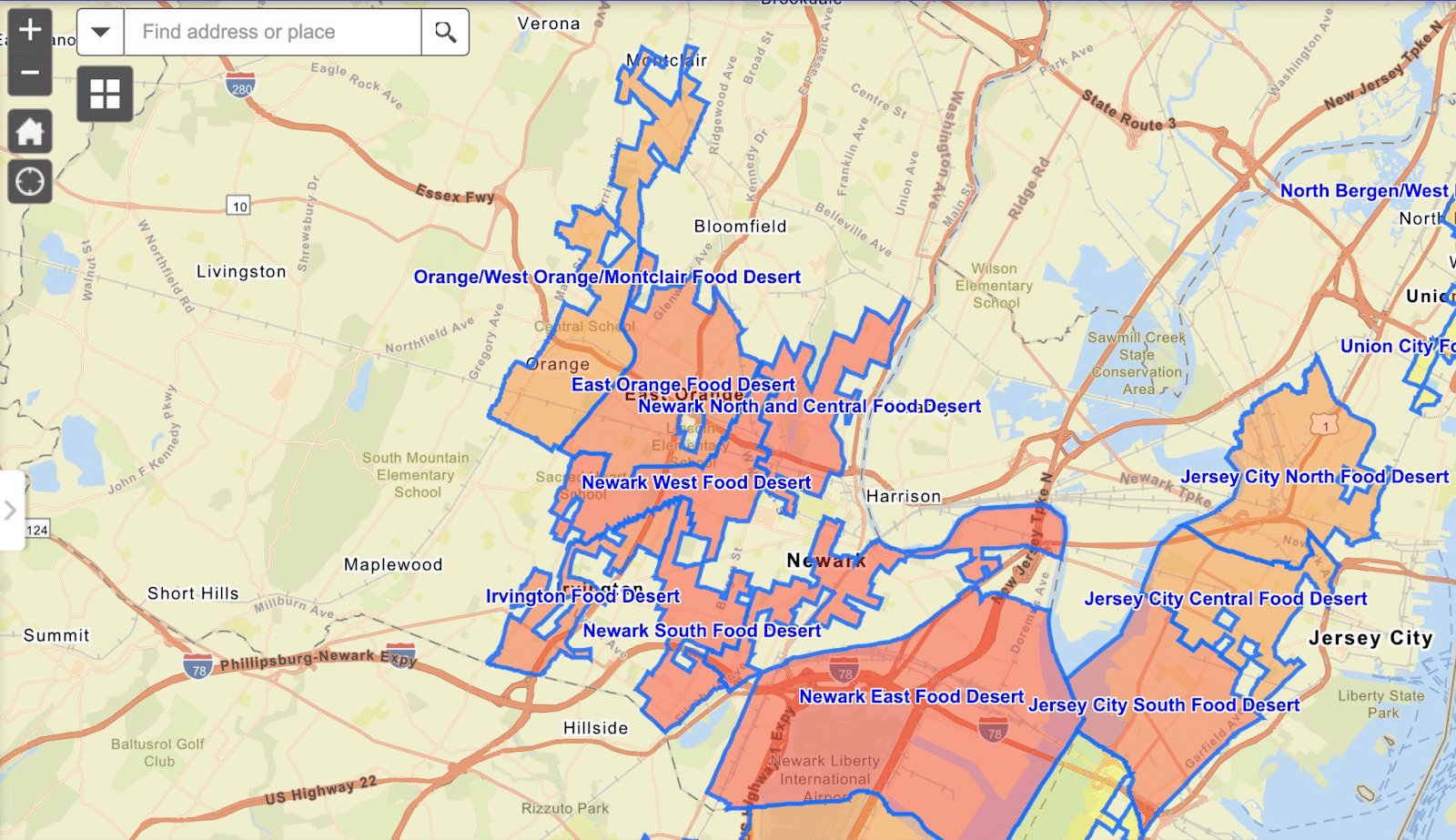
Taken together, areas of Orange, West Orange, East Orange, Irvington, Montclair, and Newark are some of the most inaccessible in the state, according to a 2022 New Jersey Department of Community Affairs food deserts map. People in these areas may have to walk 30 minutes or more to reach a supermarket.
To meet their food needs, area residents turn to a network of food pantries and soup kitchens to supplement their diet. One 2019 directory listed more than 90 food pantries and 20 soup kitchens in Essex County, but it’s unclear how many pantries are still operating. They receive food from local donations and area food banks, which collect and manage the regional distribution of supplemental food.
Most area food pantries are volunteer-run efforts, often through local institutions like places of worship or community centers. They can serve up to a few hundred families weekly.
Very few food pantry operations are more established, with dedicated staff, office space, and vehicles to support the gathering and distribution of food. They can serve up to a few thousand weekly. Even then, they struggle to meet demand.
A New Jersey Pandemic Relief Fund report found food pantries’ biggest challenges were funding and volunteers. In some cases, staff reported donating money out of their own pockets to purchase food. And a shrinking volunteer pool makes meeting increased demand more daunting.
Food banks and pantries are also limited in the quality and variety of the food they can provide because much of it is leftover from farmers, corporations, and local businesses. As a result, the food may be expired or close to expired and inedible to people with dietary restrictions.
“I don’t know any food pantries that really cater to everyone. I wish there was more thought,” said one food pantry guest about the lack of options.
He said he wishes there was more variety of food, especially for the Black community. He has a family member who is lactose intolerant, gluten-free, and allergic to seafood and eggs. When she goes to pantries, she can’t eat half the food or they don’t know how to address her food intolerances.
“When I asked them, they’re confused. Like: ‘What is that? What does that mean?'” he said.
Essex County’s Black and Latino communities are doubly burdened by this system: They are more likely to need food aid due to New Jersey’s racial wealth gap. And they are more likely to live in an area with limited access to grocery stores and food pantries as a result of the segregation, disinvestment, and discrimination that maintains that wealth inequality.
“There isn’t enough good, healthy, quality food in the areas that I live in, and honestly my area of Irvington because I’m [at] the border of Maplewood and Hillside, is little better. But I used to live towards Newark, and that was much more difficult,” said one resident.
“Maplewood and Hillside are more suburban. More white people live in those locations. Where I was living before, closer to Newark…it was a lot of fast foods, so you see a lot of unhealthy choices.”
What we’ve heard
We’ve heard that the challenges facing the food ecosystem come from all directions.
- Food pantry organizers identified a need for more culturally relevant, quality food and second-language speakers to support guests, especially Spanish, Haitian Creole, Mandarin, and Portuguese speakers.
The current pantry supply chain model can also often be laborious and inefficient, increasing recipient waiting times and diminishing food freshness and quality.
- Food pantry guests have raised concerns about long pantry lines, low-quality food options, and inconsistent distribution hours.
“I’m surprised the lines are crazy long. They’re unorganized. You know, standing hours in the cold. It’s awful,” said one pantry guest.
Pantry foods are often expired or nearly expired. “You’re getting secondhand food, bottom of the barrel sometimes.”
- Food access policymakers and advocates have said thinking beyond supplemental food distribution and towards long-term economic outcomes is a priority. The Jersey Bee is part of several local health coalitions, and we look forward to exploring how our local news service could help improve food access across Essex County.
Who this reporting is for
We will examine the toll of the current food system on the people who are most affected by it. In our process, we’ll center the information needs of historically marginalized communities in the area—low-income, Black, Latino, immigrant, seniors, and others—that are disproportionately impacted by systemic gaps without ascribing hunger to one group or neighborhood.
This reporting isn’t just for residents who are food insecure. It’s also for the public and policymakers to better understand the issue and work towards effective solutions to address the current system’s shortcomings.
Not everyone may struggle with hunger, but the impact of these faulty system ripples across the state. Food Research & Action Center reported in 2022 that food insecurity costs New Jersey an estimated $1.3 billion each year, with severe implications for peoples’ lifespans, learning ability, and chronic health conditions.
What’s next
Over the coming months, expect The Jersey Bee to deepen our coverage of the state of food access in New Jersey, particularly Essex County.
You’ll hear more from me, Kimberly Izar, The Jersey Bee’s public health reporter. I’ll share hyper-local resources on where to find food aid in your area and interrogate the roadblocks, policies, and ideas that could transform the lives of people most vulnerable to food insecurity.
Here’s a preview of some of the questions we’re looking to answer.
- What is the lived experience of those most vulnerable to food insecurity? We’re especially interested in learning from BIPOC, undocumented, LGBTQ+, veterans, people with disabilities, immigrants, ESL speakers, and residents in areas that are more likely to be food deserts.
- What are the limitations and opportunities of the current system to meet Essex County’s diverse food needs, such as food pantries, school meal programs, and state and federal aid?
- What should the future of food in Essex County look like to meet the needs of the communities living here? We’ll look at how municipal, state, county, and state governments can play a role in creating a food system that meets the needs of Essex County residents.
Share your experience
Help guide The Jersey Bee’s reporting by sharing your experience. People who’ve received food assistance, food aid organizers, and food security advocates are welcome to use the form below. You can also send stories, tips, or other information you’d like to share to kimberly@jerseybee.org.
Authors


Related Articles
How to deal with heat waves and hot weather in New Jersey
The average temperature in New Jersey is rising faster than most of the U.S. Here is what residents should know about heat waves and dealing with hot weather.
Meet the Democratic candidates running in NJ-11 special election primary
Learn about the candidates running in the Feb. 5 Democratic primary for the 11th congressional district special election in New Jersey.

How New Jersey fills congressional vacancies
Here is the process for filling vacancies in the U.S. Senate and House of Representatives in New Jersey.
