
How to run for mayor and council in your Essex County town or city
Municipal mayors and councils play an important role in things like public health and safety, libraries and recreation, and public works. Here’s how to get your name on the ballot to serve as mayor or council in an Essex County community.

New Jersey residents running for mayor or council in their town or city must run in May or November elections, depending on their municipality’s local election cycle.
Most New Jersey municipalities hold elections in November to coincide with state and federal elections, but a few dozen still hold local elections in May.
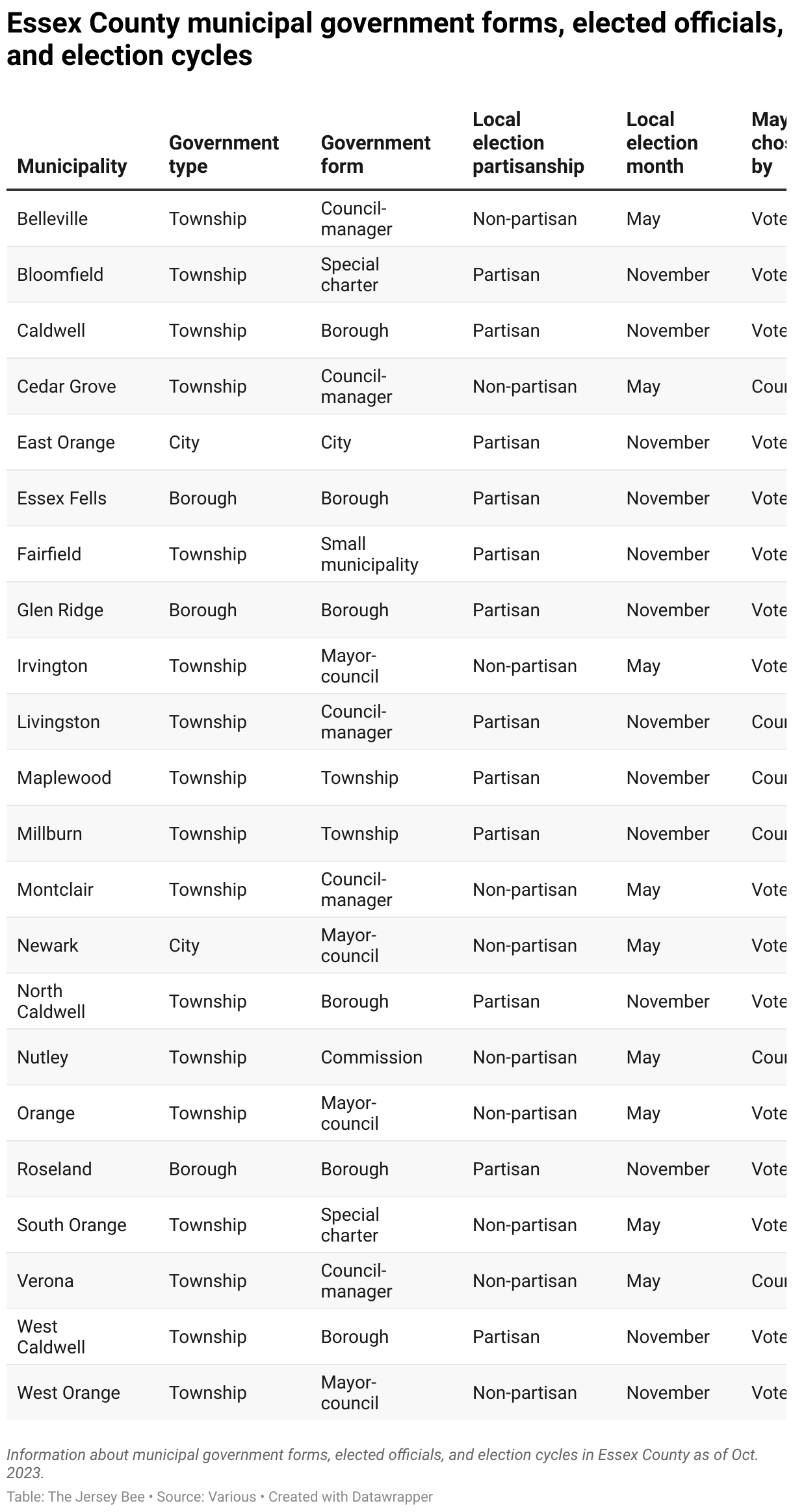
In Essex County, 13 municipalities follow a November election cycle, which includes a June party primary election. Nine hold local, nonpartisan elections in May.
The Jersey Bee produced this explainer to help prospective candidates understand the timeline for running for mayor and council in any of Essex County’s 22 municipalities.
What are town or city councils and mayors and what do they do?
Town or city councils are elected public officials who oversee municipal government policy and departments. This includes:
- Municipal parks and recreation.
- Municipal police and fire departments.
- Municipal housing and land use policy.
- Municipal health and emergency services.
- Municipal courts.
- Municipal public transportation services.
- Municipal public works like:
- Waste management.
- Snow removal.
- Road maintenance.
- Water quality testing.
Elected council members introduce and vote on ordinances, engage with the public and municipal departments through boards and commissions, and create budget plans for municipal spending on public employees and services.
Mayors are the chief executive of municipal governments and elected by voters in 17 of Essex County’s 22 municipalities. In Cedar Grove, Livingston, Maplewood, Millburn, and Nutley, council members select a mayor or council president at an annual reorganization meeting.
Mayors are responsible for enforcing all state laws and municipal ordinances. They chair the municipal council and lead council meetings. Mayors also sign municipal obligations, including state and county-issued bonds and contractual agreements.
New Jersey mayors may appoint department heads and administrators depending on the municipality’s government form.
What are the election cycles for mayor and council in Essex County towns and cities?
Essex County municipalities hold partisan and non-partisan elections.
In partisan elections, candidates must seek their party’s nomination in June primaries. In non-partisan municipal elections, candidates are elected in May.
Depending on the municipality’s government form, elected council and mayor terms are either three or four-year terms, staggered or concurrent. Review the table below to learn about Essex County municipal government election cycles.
What are the qualifications to run for mayor and council in Essex County towns and cities?
Candidates for mayor or council in Essex County must be at least 18 years old, a registered Essex County voter, and a resident of the town or city they’re seeking office in for at least one year.
Some towns and cities require candidates running for a ward council seat to reside in that ward for a minimum amount of time. Check with the local municipal clerk to confirm.
How do I get my name on the ballot for mayor or council in a non-partisan municipal election?
Essex County municipalities that hold non-partisan elections include:
- Belleville.
- Cedar Grove.
- Irvington.
- Montclair.
- Newark.
- Nutley.
- Orange.
- South Orange.
- Verona.
- West Orange.
Those interested in running for mayor or council in these Essex County communities must obtain a nominating petition from their municipal clerk’s office. They’ll use it to collect signatures from qualified residents endorsing their candidacy.
Check with a local municipal clerk to confirm when their office begins providing petitions to candidates.
All non-partisan elections in Essex County occur in May, with the exception of West Orange, which holds its local elections in November.
Completed petitions for most non-partisan municipal government elections are due to their respective municipal clerk by 4 p.m. sometime in early March, 64 days before municipal elections in May.
As of 2023, completed petitions are due in West Orange in early August, 64 days before the November municipal election.
The number of signatures required for a petition may vary across municipalities and change year to year, depending on the turnout during previous elections. Check with a local municipal clerk to confirm the number of signatures required for an upcoming election.
Newark, for example, requires a number of signatures based on a percentage of each ward’s turnout in the previous election.
Signatures must come from registered voters within the municipality or ward where the candidate seeks office.
Some towns or cities limit the amount of petitions a voter can sign. Check with a local municipal clerk to learn how many endorsements a voter can make for mayor, at-large council, and ward representative.
How do I get my name on the ballot for mayor or council in a partisan municipal election?
Twelve of Essex County’s 22 municipalities hold partisan elections where candidates must run under a party affiliation following a June primary election or as an independent candidate in the general election. They include:
- Bloomfield.
- Caldwell.
- East Orange.
- Essex Fells.
- Fairfield.
- Glen Ridge.
- Livingston.
- Maplewood.
- Millburn.
- North Caldwell.
- Roseland.
- West Caldwell.
Residents interested in running for mayor or council through the Democratic or Republican Party must gather signatures to petition for their name to be added to the June primary election ballot.
Candidates who qualify to run in a party primary can lobby party leaders for an endorsement or run under their own slogan.
Primary election petitions are typically available at municipal clerks’ offices in late January or early February. Completed petitions for partisan primaries are due to their respective municipal clerk by 4 p.m. on a date in late March, 71 days before the primary election. Refer to the Essex County Clerk’s website for the latest election dates.
To make it on the ballot, candidates must collect at least 50 signatures in municipalities with a population greater than 14,000. In municipalities or wards with a population below 14,000, at least 25 signatures are required.
Signatures must come from municipal residents legally allowed to vote and registered under the same political party as the candidate collecting signatures. Voters endorsing ward council candidates must also live in the ward the candidate is running to represent.
Check with a local municipal clerk to confirm how many nominating petitions a voter can sign per election cycle.
Residents not registered with the Democratic or Republican parties or those switching parties can sign the petition of a candidate of the party they intend to declare. But their signature will only be counted towards the candidate’s total number of signatures if the county has received the resident’s change of party form by the date the petition review begins.
Can independent candidates run in partisan municipal elections?
Candidates interested in running independently for mayor or council in a partisan election must complete the petition process through the Essex County Clerk’s Office.
Petitions become available for independent candidates in early April. They are due to the Essex County Clerk’s Office by 4 p.m. on that year’s primary election date in early June.
The number of signatures needed for an independent run for mayor or council in a partisan election is determined by the county clerk. It varies year to year and is a proportion of the number of people who voted in the last general election or other minimum.
Qualifying independent candidates appear on the ballot during the general election under their slogan.
Independent candidates can collect signatures from municipal voters of any party affiliation, including those not registered with a party.
Petition signers must also live in the ward the independent candidate is running to represent if they are running for a ward council seat.
Party-affiliated voters can sign petitions for independent candidates in addition to the petitions of candidates running in their party’s primary election. Voters can sign one petition for mayor, three at-large council candidate petitions, and one ward council candidate petition per election cycle.
Learn more
Candidates must file all financial contributions they accept during their campaigns with the New Jersey Election Law Enforcement Commission (ELEC). Learn more about campaign finance laws here.
Help improve this resource
New Jersey municipal government is a complicated subject. Help The Jersey Bee improve this resource by volunteering your expertise on the subject. Contact us here or email connect@jerseybee.org to learn about ways to help us explain this subject to our community.
Authors


Related Articles

How New Jersey fills congressional vacancies
Here is the process for filling vacancies in the U.S. Senate and House of Representatives in New Jersey.

How to recall elected officials in New Jersey
Learn about the rules, timelines, and requirements for removing elected officials from office before their terms ends in New Jersey.

Cómo funciona el control de alquileres en Nueva Jersey
Más de un tercio de los hogares del estado alquilan sus viviendas, pero no existe un sistema estatal de control de alquileres. Aquí te explicamos cómo averiguar si estás protegido por las normas de control de alquileres en tu ciudad o pueblo de Nueva Jersey.
